




If you're not dynamically pricing your walk-up window, you're probably leaving money on the table.
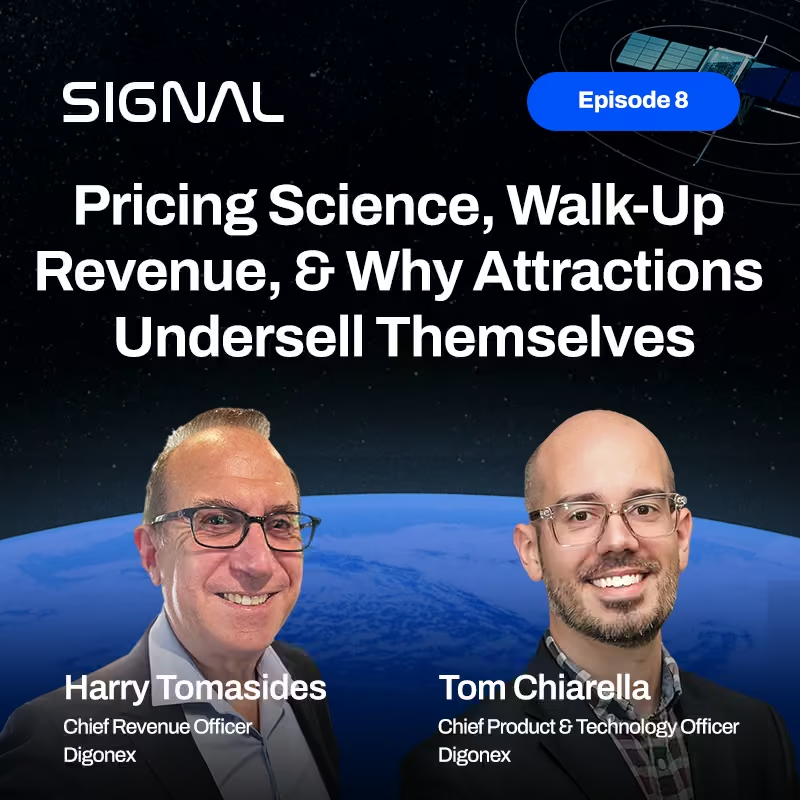
In this episode of Signal, hosts John Pendergrast and Tim Samson sit down with Harry Tomasides, Chief Revenue Officer, and Tom Chiarella, Chief Product & Technology Officer, at Digonex—one of the industry's most established names in pricing science.
With a team of PhD economists who don't just run algorithms but provide human-supervised price recommendations, Digonex has spent over a decade helping attractions, performing arts venues, and live entertainment organizations rethink their approach to pricing. What makes their approach different? Operators can approve, reject, or override every recommendation. It's pricing science with a human touch.
Harry and Tom break down what dynamic pricing actually means (hint: it's not the same as rules-based pricing), why the walk-up window is chronically underpriced, and the biggest mindset shift attractions need to make: stop underselling yourselves.
You’ll hear about:
- What pricing science actually looks like in practice—from booking data to weather to price elasticity
- Why "rules-based pricing" isn't the same as dynamic pricing (and why that distinction matters)
- The walk-up pricing problem: why there's "no daylight" between online and gate pricing at most attractions
- How one client went from "we'll never charge $40" to comfortably pricing at $45—with no guest blowback
- Why attractions consistently undersell themselves compared to performing arts and live entertainment
- The role of AI in pricing: where it helps, and why human oversight still matters
- How OTA distribution fits into a dynamic pricing strategy—and why commercial agreements often get in the way
Timestamps:
(00:45) — Introduction: Meet Harry Tomasides and Tom Chiarella from Digonex
(01:51) — How the pricing conversation has evolved over the last decade
(03:04) — Tom's journey from Gateway Ticketing to Digonex
(04:19) — What pricing science actually looks like in practice
(07:06) — Keeping humans in the loop: why recommendations beat black-box algorithms
(09:05) — The data inputs that drive price recommendations
(10:59) — Why Tom made the career shift to dynamic pricing
(12:42) — The generational perception problem: is dynamic pricing a "money grab"?
(15:08) — The optics of pricing and why it's deeply personal for clients
(17:01) — Execution matters: How Shedd Aquarium messages dynamic pricing
(20:24) — Guest experience and crowd smoothing through pricing
(22:48) — Comfort levels: from "never $40" to $45 without blowback
(27:48) — Defining dynamic pricing vs. rules-based vs. variable pricing
(31:45) — Where AI fits—and why it won't replace economists yet
(35:11) — Walk-up dynamic pricing: why it's essential, not optional
(38:25) — Why so many operators aren't doing walk-up dynamic pricing
(42:05) — OTAs and distribution: getting dynamic pricing across all channels
(46:33) — Helping operators keep control of pricing across channels
(50:01) — The "Jake problem": transitioning from instinct to data-driven decisions
(51:35) — Behind the scenes: when implementation goes wrong (and right)
(54:53) — What attractions can learn from performing arts pricing
(56:55) — Why attractions undersell themselves—and what to do about it
(59:14) — Lightning Round: pricing hot takes from Harry and Tom
About Harry Tomasides
Harry Tomasides serves as the Chief Revenue Officer at Digonex, the industry leader in customized, automated dynamic pricing solutions for attractions and live entertainment. Since joining the company in 2015, Harry has played a pivotal role in driving both domestic and global growth.
Digonex's success can be attributed to its cutting-edge pricing solutions developed by their in-house team of PhD Economists and an ever-expanding network of partnerships with ticketing providers. Digonex has a broad portfolio of clients, including Herschend Family Entertainment, Shedd Aquarium, Georgia Aquarium, Sky Deck, Bronx Zoo and BridgeClimb Sydney.
Prior to joining Digonex, Harry served in management roles with ABC/Disney and iHeart Radio.
Connect with Harry on LinkedIn.
About Tom Chiarella
Tom Chiarella leads product and technology at Digonex, the leading provider of dynamic pricing solutions in the attractions, performing arts, and live entertainment industries. With over a decade of progressive product management experience in ticketing and admissions technology, Tom was previously EVP and Head of Product at Gateway Ticketing Systems, Inc. and past President of the Board of Directors at OCTO. Tom now serves on OCTO's inaugural Membership Advisory Board.
Connect with Tom on LinkedIn.
🔗 Links & Resources
- Learn more about Digonex
- Connect with Harry Tomasides on LinkedIn
- Connect with Tom Chiarella on LinkedIn
- Learn more about RocketRez
- Follow John and Tim on LinkedIn
About Signal
Signal is the podcast for attraction leaders shaping the future of guest experiences. Hosted by John Pendergrast and Tim Samson, we bring you candid conversations with industry innovators who are building the experiences that bring people together.
Subscribe to Signal wherever you get your podcasts, and visit signal-podcast.com for more episodes and resources.
This episode of Signal is brought to you by RocketRez - powering the world's most successful attraction operations.
Harry Tomasides (00:00)
Why wouldn't it be different? Why wouldn't you dynamically price the walk up? there's typically no daylight between the online price and the price. There's arguably a lot of revenue left on the table if you don't. Otherwise, it could be called dynamic discounting.
Tom Chiarella (00:15)
If there's one thing that I think the attractions industry could learn from the live entertainment and performing arts industry, it's know the value of what you're providing and own it. you're providing an incredible experience
John Pendergrast (00:26)
Yeah.
Tom Chiarella (00:29)
for your guests. don't undersell yourselves.
Tim Samson (00:45)
Today we're joined by two leaders from Digonex, one of the industry's most established names in pricing science. Harry Tomasides has spent over a decade helping attractions and live entertainment venues rethink their approach to pricing. As Digonex's chief revenue officer, he's helped expand the company's portfolio to include major zoos, aquariums, observation decks, and performing arts organizations around the world. Tom Chiarella is is Digonex's
product and technology officer bringing deep technical expertise from his time leading product strategy at Gateway Ticketing. Tom has also been instrumental in advancing open connectivity standards across the attractions industry. What makes Digonex's approach different is their team of PhD economists who don't just provide algorithms, they provide price recommendations that operators can approve, reject, or override. It's pricing science with a human touch. Today we're going to dig into
what actually goes into recommending the right price, why operators have leave money on the table at the walk-up window, and where pricing is headed in an AI-driven future. Harry and Tom, welcome to Signal
Harry Tomasides (01:50)
Thank you.
John Pendergrast (01:51)
So we're just going to jump right in. Harry, you've been at Digonex for over a decade now, watching the industry's relationship with pricing evolve. How has the conversation changed from where you started to what you're hearing from operators today?
Harry Tomasides (01:56)
Yes.
It's a little bit more educated. Most organizations are still doing static pricing, but they are all thirsty for more data-driven approaches to making decisions on pricing. It's just, how are they going to get there?
Tim Samson (02:05)
It's a little bit more
We're going to change
Thank
Harry Tomasides (02:21)
I think they feel like they have a lot of data at their fingertips, but they don't quite how to use whereas maybe 10 years ago, data wasn't as much a part of the conversation, it was just a budget conversation on how much are we going to raise our prices in this budget season for next fiscal year.
John Pendergrast (02:42)
Yeah, so like that, I've said this before on other podcasts, that drowning in data but starving for insights kind of scenario is kind of where you feel that we sit right now.
Harry Tomasides (02:48)
Yeah. Yes.
John Pendergrast (02:50)
Yeah, I would agree with that. And that's what we see too.
Tim Samson (02:54)
And Tom, you joined Digonex earlier this year after spending years at Gateway on the platform side. What drew you to the shift and what's the biggest adjustment coming from platform to pricing science?
Tom Chiarella (03:04)
Yeah, so what drew me into Digonex were the people.
and the product. So Digonex has an incredible team of talented employees, like not only economists, but our customer success team and our engineers and our developers. And had a lot of conversations with Greg Lohan at the time, a previous CEO of Digonex, who drew me in conversation by conversation with warmth and strategic leadership, hand in hand. And I'd say the
biggest adjustment is being on the other side of those conversations when it comes to integrations.
John Pendergrast (03:42)
Right, yeah. That would be
Tim Samson (03:43)
Hehehehehe
John Pendergrast (03:44)
a pretty
big adjustment.
Tom Chiarella (03:45)
Yeah,
I was used to saying, I'm sorry, but you're not quite first on our roadmap right now. And now I'm begging to be at the top of the stack. It's a big shift for me in that regard.
Tim Samson (03:56)
hahahaha
John Pendergrast (03:56)
you
Yeah, yeah, it's a good time. so let's start with what Digonex actually does. You have a team of PhD economists, which by the way is such a great tag line, I wish I could say that team of PhD economists or data scientists or whatever,
What does pricing science actually look like in practice when you're working with an attraction? And either of you can answer, or both of you.
Harry Tomasides (04:19)
I think just like any other organization, you know, it's first understanding what their goals and objectives are . Where our economists come in is paving the path to get there. a lot of time spent on understanding.
Tim Samson (04:33)
There's lot of time spent on
Harry Tomasides (04:35)
the goals and objectives of the organization. And having a way to, it's why these integrations are so important, having a way to pull in all the data in an
Tim Samson (04:36)
people, of the organization. having a way there's wide integration for a way to blend all the different aspects.
Harry Tomasides (04:48)
automated way from a particular ticketing platform, and then overlay that with
the different 30 goals and objectives they have, whether it's attendance or growing membership or shifting attendance, whatever it is. And then the other piece of that too is when we deliver the recommendations, the things that go into that are the goals and objectives. But also, what's the pattern of behavior that the patrons are
are going on the website. is there conversion of tickets? And if there is, or if they're buying too fast, what does that mean in terms of price? How do calendars factor know, local and regional school calendars factor into the pricing? And I think one of the biggest things where an economist can come in,
Tim Samson (05:34)
I think one of the things is that the that they
come in, it is really time for them to that relevant to their So I appreciate your time.
Harry Tomasides (05:43)
is really understanding what price elasticity means and how that's relevant to a zoo, to an aquarium, to a theme park. So the price elasticity may mean,
different prices for different days and what is the consumer responding to. Or it could also mean if we're doing different prices for different
Tim Samson (05:57)
different prices for different days. So,
Harry Tomasides (06:08)
times of day, what's the price elasticity between those relative days or times of day as well. And you know things like strength
of value proposition, any kind of macroeconomic factor. So it's a lot of things that I think that make just logical sense. So it's not like this scary big
science monolith. But it's really a lot of things that make sense that go into making pricing decisions. It's just that these happen to go into an algorithm that analyzes the data and provides the price recommendations.
Tim Samson (06:44)
I'm going to analyze the data.
John Pendergrast (06:49)
I have this picture in my head of like the council of Elrond with all except they're all economists sitting around a table and they're all sitting there and the data
Harry Tomasides (06:52)
Hahaha
John Pendergrast (06:56)
comes in and then they deliberate and they send it back out again. But ⁓ I get there's a lot of moving parts in what you just said. Weather yeah, there's a lot of parts.
Harry Tomasides (07:04)
Weather. Yeah, weather.
Tim Samson (07:06)
Yeah,
There's a lot of weather right now You know you guys come at a More from a different angle, but a deliberate choice and you're doing pricing recommendations Not just pricing changes when it comes to that And keeping a human in the loop why why does that matter? Why did you guys choose to do that?
Harry Tomasides (07:23)
to keep a human in the loop from a client perspective or from an internal, from a company. Yeah, so.
Tim Samson (07:28)
No, from your, your economists, like you're, you're not just relying
on the algorithm. You're relying on kind of that human touch and experience.
Harry Tomasides (07:34)
Yeah, so
I think a couple things and Tom, feel free to interject because I feel like I've taken over the conversation. I apologize. Thanks, Tim. You know, if you think about AI, machine learning, things like that, which is utilized,
Tim Samson (07:42)
We didn't notice. No.
I
utilize
Harry Tomasides (07:56)
in our price recommendation
Tim Samson (07:56)
the enterprise
Harry Tomasides (07:57)
having human oversight of that important because there's still logic that goes on behind the price recommendations and that's where the economist comes in. So they'll build the solution, but it's still going to be supervised and overseen by the economist because
Tim Samson (07:58)
After the number because...
mean, the place recommendations, and that's where the economists come in. So they'll build the solution, be and can oversee by the economists
there just a reaction with they have like,
Harry Tomasides (08:16)
There just needs to be human interaction with that. And then so they, they have eyes ⁓ on
those recommendations. And then the other piece of it it's always been important for us not be a black box to where there's just prices going out there.
Tim Samson (08:27)
enough of it to I think
always, it's important to work to have the final input on it, number one. And number I think an explained success manager, the day to day say.
Harry Tomasides (08:31)
We've always felt it's important for the client to have the final input on it, number one. And number two, to have a client success manager, a day-to-day person
clients kind of think through things and also have the economist be part team as well.
John Pendergrast (08:52)
Yeah. Tom, maybe I'll ask you this question because it's kind more on a data side question. What inputs actually drive a recommendation? what data are we looking at? And what do the economists are actually pulling up?
Tom Chiarella (09:05)
Sure, so yeah, there's quite a few data points. So first you have all of the booking data from the resident ticketing platform. And also the admissions data as well from that platform. So not only real time, but historical, right? So that kind of lays the foundation for what have prices and attendance been like over the years prior to a operator using dynamic pricing. And then...
Tim Samson (09:05)
All right.
John Pendergrast (09:13)
Yeah.
Tom Chiarella (09:29)
Getting that information real time as well to shape how is pricing performing, how is attendance performing? And it's not just for the products that we're pricing, but also for any products that would, let's say, get admission to the attraction at the same time. Is there somewhat viewed as competing products to the ones that we would be pricing for an attraction. So maybe they're only having us price some of their products and not all of them. So we also take in the attendance information and the sales information for those products.
as well. Weather, as Harry mentioned previously, we have price of fuel, the price of petrol, depending on the region. We have a lot of macro and micro economic factors from not only where the operation is, where the operator is, but also where their guests are coming from.
Tim Samson (10:14)
I don't know where they are coming
from.
Tom Chiarella (10:17)
that influence pricing as well. think web traffic, Google Analytics
data, see customer behavior. one of the things that's interesting too is like we do have that consideration for our nonprofit clients who they also have membership programs. And how does membership sale data and the conversion from a ticket purchaser to a member influence?
Tim Samson (10:28)
Yeah. ⁓
Tom Chiarella (10:45)
the pricing for maybe the general admission or the time ticket to that nonprofit operation where they might convert that person to a member later on. So these are lot of the factors
John Pendergrast (10:55)
Yeah.
Tom Chiarella (10:56)
that might be missing. I might be missing a couple here or there, but those are the major ones.
Tim Samson (10:56)
Yeah, there might be existing, there be existing a couple here where they have a couple.
John Pendergrast (10:59)
So ⁓
I come from the technical side as well. And so ⁓ maybe I'll ask a question off script, because I love going off script. It's so much more fun. What drew you? I mean, Harry's been here forever. So I mean, we can ask Harry this question too, Harry's been here forever. What drew you? When you woke up one morning and said, you know what, it's time to move on. I need to go do something else. And you're like, you know what I really want to do? Pricing. Like, what drew you into internet?
Tim Samson (11:01)
I thought you were going say that. So, I'm going to ask you question. I love your answer. What gave you the ability to care for animals? So, that being the opposite, that there is a right to do it. Thank you for your I you've talked about one where you're spend your life planning on animals. You would have, aren't you?
Tom Chiarella (11:03)
Mm-hmm.
Hahaha!
Tim Samson (11:25)
Ha ha ha ha ha ha ha ha
Tom Chiarella (11:27)
Yeah. ⁓ it was, it was just like that, John. ⁓ you know, I woke up one morning now and all, all seriousness, the concept of dynamic pricing and all of the thought and research and development and all of the academics behind it were very intriguing to me. Right. So just like a lot, like intellectual curiosity kind of got the best of me.
John Pendergrast (11:27)
you
I believe it. believe it.
Tim Samson (11:31)
Hahaha!
John Pendergrast (11:47)
Yeah. Yeah. Yeah.
Yeah, I can definitely understand that.
Tom Chiarella (11:54)
you know,
Tim Samson (11:54)
See
ya.
Tom Chiarella (11:55)
especially when you maybe we have conversations around the dinner table or with friends and family and they're talking about their view on, you know, how something they sell on Amazon is now twice as expensive as it was last week. And you say, you know, I think I'm going to make a career shift. I'm going to go work for this company who does dynamic pricing and you have the shock, the shock and the awe factor of your family and friends as well. and I was,
Tim Samson (12:01)
Thank you.
John Pendergrast (12:03)
Yeah.
Tim Samson (12:18)
You were tired
John Pendergrast (12:16)
Yeah.
Tim Samson (12:19)
of being you're tired of being the good guy you just wanted to play a villain for a little bit, right
John Pendergrast (12:21)
Yeah, you're having a villain phase?
Tom Chiarella (12:21)
Yeah, exactly.
John Pendergrast (12:23)
Yeah.
Tom Chiarella (12:24)
What I was interested in mostly though from more of a societal perspective is it's not just about increasing prices and maximizing revenues. It's also about making products more approachable and within reach of
John Pendergrast (12:34)
Yeah.
Tom Chiarella (12:42)
various social economic demographics in areas as well. you know, it's, think there's a bit of a misconception, perhaps in some circles about dynamic pricing and that, it's, it's a money grab. It's just looking for revenue, but really a lot of conversations we'll have with clients are around lowering the price of their products, making them more accessible from a base perspective. And I thought that there's a lot of good that can come from having, having your product priced at
points that are more accessible to different target demographics that you have for your facility.
John Pendergrast (13:16)
I think
there's a misconception there. I was sitting on vacation at one point with my daughter, and she turned to me and she said, first off, I've not asked for permission to tell this story, so we may have to cut this. But we'll see. I'm on the beach, I'm talking to her, and she goes, Dad, I'm not loving dynamic pricing that we're offering now. And I said, how come? And she said, because my generation especially is being punished by it.
Tim Samson (13:27)
Bye.
John Pendergrast (13:40)
And she's thinking airlines and concert tickets, right? She's like, we're being punished by it. And I think I would agree with a certain amount of that, that there are certain industries that are punishing people for it. But I proceeded to say, listen, I mean, you've got plan ahead pricing, you've got these opportunities that you might not otherwise have.
Tim Samson (13:44)
I'm going to take a few minutes get back to you.
John Pendergrast (13:55)
To go and do these kinds of things and I think that there is a kind of a hill to climb there still with especially the younger generation To try and explain why this is maybe advantageous to them not not a money grab because there is you know to your point a real dialogue out there around that so we're a little off topic, but Anyways, it's where the conversation went
Tom Chiarella (14:14)
Yeah,
no, I mean, that's, and Harry talked about, you know, the educational aspect of the work that we do. And there's still a lot of, a lot of ground to cover there as far as, what is dynamic pricing, you know, how is it best utilized? We did a session at the Arival conference not too long ago. And, that area of the industry is starting to become more aware of dynamic pricing at the smaller tour operator level.
John Pendergrast (14:21)
Yeah.
Yep.
Tom Chiarella (14:37)
a lot of questions, a lot of curious concerns. And one of the most interesting things that came out of that conversation was, there are operators who want to drop their pricing at the gate, at walk-up point of sale if they have space left in their tour or in their operation. But they had already offered a lower price for presale.
John Pendergrast (14:52)
Yep.
Tom Chiarella (14:57)
how do they balance wanting to fill the open space with someone who did do pre-sale, came up and said, well now why is the ticket less at walk-up than what I paid? So it's creating some, and those are really challenging situations and that's, I think when we talk about.
Tim Samson (15:06)
Thank
John Pendergrast (15:08)
Yeah, the optics are terrible.
Tom Chiarella (15:17)
the reasons why Digonex is a little bit different. We talk about the PhD economist, the customer success team, pricing products is, for our clients, it's very personal. We're talking about how their products are seen by the market, what support or backlash they'll get for making pricing decisions because they are public, and...
you know, because it's deeply personal, you know, we have the people in the loop, you know, as Harry mentioned, and we encourage our clients to be in the loop as well, because at the end of the day, what they decide to sell a ticket for matters.
Tim Samson (15:45)
you
Yeah.
Harry Tomasides (15:54)
Yeah.
John Pendergrast (15:55)
Well, mean,
sorry, Tim, I swear I'll let you comment in. But I was going to say this. I think that there's this intersection in why you started down this career path, as there's an intersection between human psychology, which is definitely not a solved problem, ⁓ and data science, which has more of the solved problem aspect to it. And that's a really interesting intersection between those two points. Anyways, ahead, Tim.
Tom Chiarella (16:04)
Mm-hmm.
Tim Samson (16:06)
Thank you. ⁓
No, I mean Tommy touched on you touched on an interesting point and like I saw when we implemented dynamic pricing at Morey's. but I see it across a bunch of people and it's this need to Fill the vessel or sell all the inventory or do these things? and and you don't need to because When you do pricing right, the revenue is higher your total amount of revenue is higher
And by by leaving those empty, you actually allow for a higher price point and not undermining your own price. I think that's difficult because a lot of times even as technologists within the industry, we do have really good job in the first part. Like these are all the reasons you should do it. But we don't necessarily do a good job of like, and this is how you should engage with it. this is how you should keep these things going. Yeah.
Harry Tomasides (17:01)
here's the execution. Here's the
execution. I think that's a really big piece of the discussion. You know, there are organizations out there, say Shedd Aquarium, for instance, they do a masterful job messaging dynamic pricing, what the
to the guests are how the guests can make it work to their benefit. That's a key part, not only with the attractions business, and also which is not necessarily relevant for this particular discussion, but also for the live entertainment business as well.
John Pendergrast (17:39)
Yeah.
Harry Tomasides (17:39)
which kind of goes I think you said your daughter's ⁓ pushback on it like if there are guardrails put in that we're never going to go above this price or we're only going to do this and you know, we have rules set in there. You know, a lot of this is still in control of client, whether the client is the
John Pendergrast (17:43)
Yeah, yeah, yeah.
Harry Tomasides (18:01)
the attraction or the client is the artist. They still have things in their control you know, they can activate that.
John Pendergrast (18:09)
So how often do, I mean, it's a good question. How often do customers and clients come to you and say, love the analysis you gave me, it's beautiful, love it, also, I don't want to do that, I want to do something completely different? They can approve and reject and like do these kind of processes through the portal, but how often do they just go, I disagree? Does that happen?
Tim Samson (18:21)
Yeah.
Harry Tomasides (18:22)
Yeah
like disagree with ⁓ recommendations or say, yeah, I mean, rarely, we hope never, but it happens. I mean, sometimes there may be something that happens, you know, at the, let's say it's a zoo where an animal exhibit shuts down or something like that. And then you can make price changes.
John Pendergrast (18:33)
Yeah.
you
Harry Tomasides (18:50)
they have the ability to do it. For the most part, our clients take our price recommendations. yeah, just so they fall within the guardrails of what they set up. Are you comfortable taking?
John Pendergrast (18:56)
Right.
Harry Tomasides (19:04)
a general admission price per zoo up $10 from one day to the next day? And probably the answer is no, because that's kind of shocking, right? Is that a good customer experience? Probably not. But is it kind of iterative where it's $0.25 here, another $0.25 there, to where you can get some meaningful impact
John Pendergrast (19:13)
Yeah.
Harry Tomasides (19:31)
by doing that. So I think having those rules in place that's the way to communicate it to maybe the different generations too is like, and I always have to tell my daughter this too, it's like, as Tom said, it's not all about a money grab and always about raising prices and always, it's really about
Tim Samson (19:41)
would have to start like, my daughter would just, I've done a ton of work out of how to do that. I've felt like I try to system it's really
about like, the fact that it's like, for the insect to come
Harry Tomasides (19:52)
an effective price range that can attract
different groups of people and what fits somebody's schedule and budget the best way.
John Pendergrast (20:01)
Yeah.
Well, I mean, to riff off what you said and also what Tim said, which is you don't have to fill the vessel. You don't have to fill. In fact, there's all these studies done over COVID, right, about how the impact of getting back into travel and the fact that people had like really high satisfaction levels because the boat or the park or whatever wasn't full.
Harry Tomasides (20:22)
Yeah,
right.
John Pendergrast (20:24)
Right?
And so it's like, are you improving the experience? So we were just at We were just at IAAPA and we went to IAAPA Celebrates. that's an awesome experience because you get to go to the theme parks, but just with your closest friends, 10,000 friends or whatever it is, and it's very empty. And so you're waiting one fifth the time for rides or sometimes you just walk straight onto them.
Harry Tomasides (20:28)
Yeah, absolutely.
Tim Samson (20:43)
Thank
John Pendergrast (20:48)
And arguably that's the way I've experienced Disney and Universal most. And I think they're awesome. Then they explained to me that this is a five hour wait for this ride or like a 360 minute. And you're like, good night, I'm not gonna, like that would be terrible. And of course pricing is more than just the price, it's about balancing those kinds of things as well.
Harry Tomasides (21:09)
Yeah,
Tim Samson (21:10)
Yeah, that goes back to the results of the track and took the science right? know, spending time with the science of the network.
Tom Chiarella (21:10)
Yeah, I think it is.
Harry Tomasides (21:11)
and that goes back to the goals and objectives of the client, right? So spending time with a client saying, what is your goal? And maybe it is. We don't want to have as much overcrowding. We want to smooth out attendance. Instead of having, if it's a zoo, having 14,000 people in a day or in a time period we wanna reduce that by 15%.
John Pendergrast (21:16)
Right.
Harry Tomasides (21:36)
And then we want to ship those folks to a Wednesday or something like that. So how can you use price as a lever?
John Pendergrast (21:40)
Yeah.
Tom Chiarella (21:42)
the guest experience is a big, big part of it. And one of the other things that touch on, and it would be great for us to kind of pull this data. I'm sure we talked to clients about it, at least directionally is if you can level out your attendance and there's a little bit more space in your attraction or in your vessel.
it's likely also going to increase your per caps, right? Because a guest who's having a pleasurable experience, doesn't feel like they're elbow to elbow, who doesn't feel like it's a crowd to get to the concession stand or it's a crowd to get to the gift shop, you know, they're going to spend more at your attraction, especially if they felt like they got a good deal.
on doing a plan ahead purchase and they saved a few dollars off the price, right That becomes almost, to them, sometimes it's free money to spend at the attraction and they'll do it.
Tim Samson (22:30)
And sometimes, money.
it's my turn to go on the tangent, we talked a lot about guardrails about the attraction setting guardrails So herein lies my question Do you guys come in and say this is the price you should be at? And the attraction says we're not comfortable going that we're gonna go here
Only to end up here anyways, at the end. Because of a comfort level,
Harry Tomasides (22:48)
Mm-hmm.
yeah. So that's very common. There was a webinar, IAAPA webinar. And I remember the client saying at that point, they'd never had a four in front of their admission fee. And going into dynamic pricing, they were like, there is no way we will ever
go above $38, whatever it is. And then she was like, you know, they kept testing and testing and testing to where 45 was kind of the norm and they were comfortable with it. They didn't have any blowback from clients. And part of the reason they didn't have blowback from clients is because they had a lot of other choices.
John Pendergrast (23:12)
Uh-huh. Uh-huh. Give it two months.
Tim Samson (23:16)
Thank
Harry Tomasides (23:33)
for the guests to take advantage of. So it's a matter, of clients getting comfortable too You know, and then holding their hand, sort of that human touch is holding their hand to get them comfortable as well.
Tim Samson (23:35)
Thank
John Pendergrast (23:50)
I would say that like ticketing price inflation
like if you were to say coming into COVID and then through COVID and outside the backside of COVID I think we finally had some necessary ticket inflation like on pricing.
It was really stagnant for a lot of years in there. I think I'm almost 25 years in this industry and it was like the same pricing had existed for a decade. And then you had some price increases of people almost like discovering that they could charge more during COVID. And then you start layering in dynamic pricing in there. I think the trouble is that there is a little bit of this like airline ickiness that we kind of still have around dynamic pricing.
Harry Tomasides (24:06)
Mm-hmm.
Yes.
Tim Samson (24:28)
⁓ Darn. ⁓
John Pendergrast (24:29)
But I just gotta say this outright, and that is, if you wanna go and make money, and your job is to go and make as much money as possible, there are easier ways to do it than open an attraction. You don't open attractions
Harry Tomasides (24:40)
Yeah
John Pendergrast (24:43)
to go and make a ton of money. You open attractions, I mean, maybe if you're Disney, but I would argue that that's only part of their business. But you do it because you love it.
Tom Chiarella (24:51)
Yeah it's passion.
John Pendergrast (24:51)
And you're really passionate about the people you're serving. And you need to also cover costs of everything else rising at the same point. So I don't know. I think sometimes we have the wrong end of the stick on how we approach that.
Tom Chiarella (25:03)
Yeah, you do. And you're right, John. And also you have, you want to provide an excellent guest experience, right? And how do you make your guest experience better? And at some point it comes down to reinvesting in your property, reinvesting in your products and
Harry Tomasides (25:03)
Yeah.
John Pendergrast (25:09)
Yes. Yeah.
Tom Chiarella (25:20)
that money does need to come from somewhere. So a really good match is a guest who feels like they had an incredible experience and they have no qualms about the price that they paid and an attraction or a small operator who's able to make those incremental improvements to their facility or to their products to keep having guests come back and to continue to be able to appropriately price their products.
Tim Samson (25:20)
Thank
Yes. ⁓
Tom Chiarella (25:47)
You know, the guests and the purchasers in this space
are all very much willing to pay for a premium experience or an experience where everything was really just a pleasure and a joy and they have memories that they're walking away from, right They're probably not going to remember the price of the ticket unless it was unbounded and outrageous or.
Tim Samson (26:06)
Thank
Okay.
Tom Chiarella (26:13)
you know, they're more likely to say, Hey, Maybe I pay a couple of dollars more this year than it last year, but look,
there's something new in that attraction or now this product comes with a different perk, or maybe I can get in early if I pay at a higher fee, or I can pick a time or I can come at any time, you know, depending on how, the operation is, is balancing those things. So I think there's definitely room and space for it to be very, you know,
Tim Samson (26:21)
Yeah.
Tom Chiarella (26:40)
collaborative, know, coexisting relationship between the purchaser or the guest and the attraction.
John Pendergrast (26:44)
Yeah, I would agree with
you. It's funny, Um, I'm 50 now, so I feel like I come from a different generation on a lot of this kind of topic. But I look at it and I go, back when I was in my 20s, 20 bucks was a lot of money. And now, I was watching an ad the other day, and it was like, it's not like we're saving you a ton of money, it's only $50. And I'm like, $50?
Tim Samson (26:49)
Yep.
Mm-hmm.
Harry Tomasides (27:06)
Yeah.
John Pendergrast (27:07)
That's pretty good. I'd like if
Tom Chiarella (27:08)
Yeah.
John Pendergrast (27:08)
I
find $50 my jeans, I'd be pretty happy, right? And it's so I mean we have this kind of inflation happening as well. And I think sometimes operators really have my mentality. So I would argue a lot of operators are my age or even a little bit older at times. The owners of these companies and they have these mindsets, is $20 is a lot of money. But that's not in sync with the next generation that's coming up and saying, hey, I want to be careful with my money. But also I spend $15 a day on a coffee.
Tim Samson (27:18)
So I'm already in trouble.
Yeah.
John Pendergrast (27:33)
very... Yeah. You're two years younger than me. ⁓ that's
Tim Samson (27:33)
I feel seen. No. I know, but but you hit me with the coffee.
Harry Tomasides (27:36)
⁓
John Pendergrast (27:42)
That's the whole basis of Starbucks, All right. Let's move on to part two defining dynamic pricing
Tim Samson (27:48)
Yeah, I actually kind of have a segue from this. Like we've talked a lot about fatigue and on the consumer side with dynamic pricing and just what it means. I actually think there's some fatigue on the attraction side as well, or at least at least talking about dynamic pricing because It's really not well defined, right? Like there's not a commonality of language with it. so Tom,
Harry Tomasides (28:06)
Mm-hmm.
Tim Samson (28:10)
how would you define it and what do you think people get wrong?
Tom Chiarella (28:12)
Yeah, so this is really interesting because we did a session at Arival on this very topic and what we started with was a definition of the term. So from my perspective or maybe from our perspective at Digonex, dynamic pricing is when pricing changes in real time or near real time.
in response to a variety of factors that are happening at the attraction through the data of the attraction, the sales data, the admission data, and also any micro, macro economic factors that would also influence pricing and that it is typically driven by an algorithm and also can be further informed by
by other business intelligence and insights that might be available to the operator, which I would say is different than rules-based pricing.
which is when as an operator, I have gone into my booking platform or my ticketing system and I have configured a few or many, if this, then that rules to my pricing, or I have created calendars and time slots to drive my pricing, which I'd say is more either like rules-based pricing or variable pricing.
John Pendergrast (29:31)
Can I argue with you for second here? Because I think that's what makes great content. you have... Yeah, I'm Canadian. I'm Canadian. Yeah, totally. We're nice people. We'll still say it as it is. We'll just ask first. So I actually agree with you, and so it's hard to argue, but I'm going argue with you anyways. Rules-based pricing, if you had enough rules, would you not functionally have the same thing?
Tom Chiarella (29:32)
Absolutely.
Yes.
Tim Samson (29:36)
I love that you ask if you can argue like that is the most kidney. That's the most Canadian thing you did so far today. Yeah
Harry Tomasides (29:40)
You Canadians!
Tom Chiarella (29:57)
Harry says, no, I say it would be extremely close and maybe to certain operators, it's sufficient. Right? you know, will it be the same? No, won't be the
John Pendergrast (30:00)
Yeah.
Yeah, the differences will be, yeah.
Harry Tomasides (30:09)
I think the
differences with rules-based, it's really more, let's say, booking-focused what's happening in the here and now. We're pacing at this pace We don't quite know what the weather forecast is, but we're assuming it might be this.
So it's not flexible enough because you still have humans having to change the rules if something changes. And so it's really focused more on a booking focused approach as opposed to a forecast driven approach where understanding
what the attendance will be predicted to be, what we believe the price elasticity might be. So I think there's a difference there of a booking-focused approach that's kind of like the here and now information and just responding to it, as opposed to a forecast-driven approach, which is more in line with
John Pendergrast (31:05)
Mm-hmm.
Yeah, so you.
Tim Samson (31:10)
Thank
⁓
Harry Tomasides (31:11)
Dynamic pricing.
John Pendergrast (31:12)
Yeah, so your differential there is functionally saying rules are going to be predictive.
You're going to have to be predictive on the rules and get all the rules correct. And if over an infinite amount of time, you got all the rules correct to deal with every scenario, you might get close. But functionally, that's not how real world works. You're always going to have some unique scenario that pops up that allows you to quote unquote dynamically price and change your pricing where there's a human involved. And I guess that ties back to why AI maybe doesn't answer the question yet because AI would just be a
really complex rules engine in some sense.
Tom Chiarella (31:45)
if you've seen recently, I saw on some of the social media feeds the asking AI for a random number between one and 10. And AI, self admittedly, AI says, can't give you a random number because I'm deterministic, right? And I'm built based off of rules. So I will give you the most frequent human response. And that's, think, no.
Tim Samson (31:46)
⁓
John Pendergrast (31:53)
Yeah.
Tim Samson (31:54)
Okay.
Yeah.
John Pendergrast (31:59)
Right.
Tim Samson (32:00)
Yeah.
John Pendergrast (32:05)
That's not creepy at all, Is it seven? Because
Tim Samson (32:07)
Thank you.
John Pendergrast (32:10)
I feel like it's I don't know if that's in my nerd card playing out there, but that's what, yeah.
Tom Chiarella (32:11)
Seven, it's seven, yes, seven. ⁓
Tim Samson (32:16)
Ugh.
Tom Chiarella (32:16)
That's what we're saying, yeah.
Harry Tomasides (32:18)
I think you bring up a good point, John, because AI comes up a lot. It's why humans still need oversight of it and need to know what to do with the information that's coming out. Like it could get you a little quicker and closer to what you want, but it's
making logical decisions all the time.
Tom Chiarella (32:38)
Yeah, yeah, it's definitely going to become, continue to be more prevalent in the space. It is often a fast answer and maybe it's a cheap answer as well. It brings you back to that good old like project management triangle of, you know, cost, scope and quality.
Tim Samson (32:39)
Hey.
Thank
Back
Tom Chiarella (32:58)
you know, and I think, right, will it will it get close and in a lot of places under certain circumstances, I'm sure we could run some studies and say, okay, well, AI driven pricing outperformed more economic algorithm driven pricing in these scenarios. And, that be something we have to, we have to fight against and, and, and educate against as well, because to Harry's point,
We're operating at a level of what are the goals of the attraction and where are they trying to go where a lot of the rules and AI driven recommendations are going to be based off of a narrow scope of data, I would say by comparison. there's a lot for us to learn even as humans.
Tim Samson (33:33)
Thank you.
Tom Chiarella (33:39)
working on on dynamic pricing and of course, you know, will we will we the algorithms to make ourselves more efficient? Yes, but I think it will always be a step behind,
At least when we're looking at kind of more of the long-term revenue goals or the long-term attendance goals for the attractions, you know, if I wanted to ask AI what should my price be today for this product, I'm sure it would give me an answer and I'm sure if guests would buy tickets at that price point, will it get me to my annual revenue goals for my attraction? Not so sure.
Tim Samson (33:59)
Yeah.
John Pendergrast (34:13)
I for a long time, AI struggled to add 2 plus 2. So it has gotten there now.
Tim Samson (34:18)
is it just giving the answer that most humans would give? Right? ⁓
Harry Tomasides (34:21)
Yeah.
Tom Chiarella (34:21)
Yeah.
John Pendergrast (34:22)
So it's funny
you say that. So my son-in-law is doing his masters in real math there's very little application to that other than being a professor that also teaches real math. it's not like they're developing the algorithms that will eventually give us teleporters or something. They're just like these kind of random stuff.
What's really fascinating is that if you look at it and you say, is two plus two four, he'll tell you, maybe. I'm like, no, this did not get better. And I'm talking to a human here.
Tim Samson (34:48)
Hahaha!
Tom Chiarella (34:49)
Excellent.
Harry Tomasides (34:53)
hahahaha
Tim Samson (34:55)
You
Tom Chiarella (34:56)
I would love to see the
whiteboard for that, by the way. I'm sure
John Pendergrast (34:58)
Yeah, I know, you probably wouldn't.
And he also said this, he's like, the math that we use and you're comfortable with is just one type of math. And that broke my brain right there. And I'm like, you're my son-in-law, I love you, but I have no idea what talking about anymore.
Tim Samson (35:11)
so if I'm an operator and I dynamically price walk up and online, both, are there situations and what happens if someone has paid more online for a ticket than what you can get out of the window? Like how, how do you message that consumer?
Harry Tomasides (35:27)
I don't know if we've ever done that before, or the online has been higher.
Tim Samson (35:31)
So it's not like the
Priceline commercial with the people in the pool at hotel. Right?
Harry Tomasides (35:36)
No,
Yeah, I think that. The walk up from my experience has been the most expensive that there is as opposed to the online. I don't think any of Digonex clients have experienced where an online tickets can be more.
than a walk up. And if that is the case, think we would strongly advise the client to rethink that approach.
Tom Chiarella (36:02)
Yeah, we, this very similar to the little bit of the conversation we having earlier where, you know, it's like the, do I fill my vessel or if I have it, which is like what, so I have some, somebody who's pre-purchased online. They're doing it at a lower price. and then they walk up and what do they see? So in your scenario, Tim, right.
Well, let's say that operator did, they reduced price because they had open capacity and they wanted to sell. So what I would recommend and working working with attractions over the years, like you need to make sure that that team member who's on your front lines has the ability to do something for that guest.
Tim Samson (36:24)
this into a live session.
John Pendergrast (36:34)
Yeah.
Tom Chiarella (36:34)
whether
it's a voucher or it's a discount code or you're giving them some in attraction spending funds of some sort, they better be able to quickly serve that guest, because otherwise you're going to have a guest experience nightmare on your hands and you're going to read about it in the reviews of your attraction later. So that's one way to do it. So if you were in a situation where as an attraction, you wanted to be able to lower the price of your walk-up,
Tim Samson (37:00)
You're
Tom Chiarella (37:01)
Do it with a discount code. Do ⁓ it as the walk-up guests are approaching. You'll surprise and delight them if they're prepared to pay a higher amount and you're offering discounted prices or get it out some other way. Don't lower your advertised prices at a lower price point than somebody who purchased two weeks ago online paid for your product because it's just not a good way.
Tim Samson (37:02)
Mm-hmm.
Thank
Thanks.
John Pendergrast (37:20)
just yeah.
Yeah.
Well, I people are fine with going, I spent $100 to bring my family to this attraction, but I bought six weeks ago. And if I buy it at the window, it's $160. Right? Like I think people are right with that. Or even standing next to someone who just bought it at the window and went, oh, I paid $160. That family only paid $100. Even if they were to ever find that out, there's still a little bit of, OK, I should have done my homework. I'll do it next time.
Tom Chiarella (37:37)
yeah.
Yep. Yep.
Tim Samson (37:53)
Who
got the black Friday deal versus who decided to buy on Christmas Eve?
John Pendergrast (37:56)
Yeah. Yeah.
Tom Chiarella (37:59)
Mm-hmm.
John Pendergrast (37:59)
And I don't think that's predatory. I think that's just that's just literally if you're going to not do any planning, then you can expect to pay a higher price.
Tim Samson (38:05)
I also don't think that people are saying like, I paid a hundred for a ticket, what did you pay? Right?
John Pendergrast (38:10)
No, no, I'm not sorry. That's a good thing.
Harry Tomasides (38:10)
Yeah. Yeah. No.
Tim Samson (38:14)
So on that note, we've talked a lot about pricing, I think it's assumed that we're talking about pricing online, But something that sets you guys apart is you're also doing price changes for the onsite, you know, or at the ticket window thing. Why is it a big deal and why do you think so many people are not doing it?
Harry Tomasides (38:25)
Correct.
I think they're not doing it because they're scared and they don't know how to execute it. you know.
Tim Samson (38:35)
But what price
do we put on the brochure?
Harry Tomasides (38:37)
yeah, yeah. And so I think a lot of
it is how it's executed and providing them to do it. But sometimes it's a bit of a conversation. Most part, there's really wide acceptance and it makes a lot of sense the walk up is going to be different than. And if you think about it like
Why wouldn't it be different? Why wouldn't you dynamically price the walk up? And there's typically no daylight between the online price and the walk-up price. ⁓ Because there's There's arguably a lot of revenue left on the table if you Otherwise, it Otherwise, it could be called dynamic discounting. discounting.
you're always probably going to be less than whatever is determined to be the walk-up price. So what if you're saying the walk-up price is $42? Well, what's not to say that based on the different factors and variables that are being reviewed, the optimal price for that day is $47.
John Pendergrast (39:30)
Second.
Right.
Harry Tomasides (39:47)
And
so why wouldn't you?
John Pendergrast (39:52)
So that's an interesting point. I love that you call it dynamic discounting. I know that people can discount. Your customers or your clients could say, hey, listen, we want to run a discount here. Does anyone ever do that? Or is it always going up?
Harry Tomasides (40:07)
Well, they both can be true, right? So they can discount, they can do discount codes and it's going to be 10 % off And so they would put that in, but that would be attached to whatever the dynamic price recommendation is. So if it's $42 and you get 10 % off, then it would be
minus $4.20, whatever that is, and I can't think
John Pendergrast (40:34)
Right.
Tom Chiarella (40:35)
Yeah. the pricing recommendations themselves, John, so I say, if, we're doing our job correctly, we would see a steady increase in price, the closer we get to visit date. If we did it right, it should be a, you know, a steady increase as we get closer to that visit date and the, you know, thinking about the guests standing in line at walkup.
John Pendergrast (40:48)
Right,
Tom Chiarella (40:59)
You know, maybe the attraction is one of those that, you know, walk up sales and admissions is the same place, right? Physically, you're going to go there, whether you purchased a ticket or you're just scanning a mobile ticket for entry. You know, there's nothing that stops me as a consumer, as a guest, if I haven't purchased a ticket yet, you know, I'm standing in line, I'm going to open up my phone and say, okay, if I go on the website, what's the price if I buy the ticket on the website? Is that going to be different or the same as the gate?
You know, and that's a reason I think to have someone doing pricing for both e-commerce and walk up. And then that third arm that I'm sure we'll talk about at some point is, well, if I look up one of the OTA websites, what's the price of there, right? Can I go and get it even cheaper from an OTA, which I would hope is not the case for the attraction sake, right? Cause we're trying to drive those, revenues and sales through e-comm and walk up.
Tim Samson (41:50)
That was the best
John Pendergrast (41:49)
Yeah, totally.
Tim Samson (41:51)
segue I've ever heard on this podcast. Yeah.
John Pendergrast (41:52)
Yeah, it was a great segue, a really fantastic
segue because the next question is actually about OTA.
let's talk about distribution channels. Because of course, as we all know, direct sales and then online sales, like when you're doing your own direct sales.
You're just one set of channel one channel really like what do you do with all these other channels and OTAs with varying different levels of sophistication
Harry Tomasides (42:05)
Right.
Tom Chiarella (42:12)
Yeah. That's frequent, frequent question that we get, right? Is, well, do you, you also offer pricing recommendations for OTAs? And I think the answer is yes. And that depends on a number of things. one is, yeah, well they, well they take them. your OTAs pricing is only as up to date as often as they pull pricing or you push pricing to them.
John Pendergrast (42:26)
They're willing to take them?
Tom Chiarella (42:37)
Right, which is always a factor, sometimes a challenge depending on the OTA. It also comes down to what your commercial agreements are as an attraction with your OTAs What are your...
Harry Tomasides (42:48)
Yeah.
John Pendergrast (42:49)
Right.
Tom Chiarella (42:51)
agreements based off of, are they based off of a base price? Are they getting some sort of like a straight commission? Is there already negotiated prices that they have in their contracts? So some of those factors can constrain what we can do with dynamic pricing, but for the same reasons that we talked about, walk-up sales being important.
for dynamic pricing, you're pricing dynamically for e-comm, you do the same for walk-up, we would encourage you to do the same for your OTAs as well. And we have a number of integrations that kind of support that out of the box, especially if we're configuring our products in the booking platform in such a way that it's the same product or it's derivation of a product that's going to an OTA. So they're getting maybe daily updates of a base price or...
Tim Samson (43:10)
Thank ⁓
I'm not sure if I can answer that question. I will just make sure that products are broken platform in such a way that it's a great product for us to be able to the derivation of a product that's going to the HPA experience.
Tom Chiarella (43:37)
another frequency of updates that's amenable to dynamically pricing through an OTA. Where it gets tricky a little bit are on some of the...
the passes that provide you access to many attractions that are geographically restrained, like a City Pass or a Go City Pass Those can get a little bit tricky to have variable and dynamic pricing in, but I think we have a few examples where we've done some work with City Pass to help make that make sense for guests.
Harry Tomasides (44:04)
Yeah.
Yeah and I think, from our perspective to like, it's the single source of truth with the price is the ticket that goes into the ticketing platform. And then is the OTA able to consume the dynamic price? And if they're able to dynamic, you know, consume that price, then we're all good. It's just not all OTAs have
done the development work on that or prioritized it.
Tim Samson (44:32)
And then push out and talk back. But
not, I mean, it's not always technology. Sometimes it's the commercial agreements that get in the way, right? Yeah.
Tom Chiarella (44:39)
It could be commercials.
Harry Tomasides (44:40)
Yeah, yeah,
I mean, it's Tom's point, absolutely the commercial agreement. If an organization prioritises dynamic pricing, as those new agreements come up for renewal, renegotiated with dynamic pricing.
Tim Samson (44:56)
it's a revision.
Tom Chiarella (44:55)
Yeah, I'd say frequently it's a revision of an existing agreement because likely when they
inked their commercial agreement with an OTA, they were not thinking about dynamic pricing. Many of them weren't thinking about variable pricing, right? And they're very, I say simple but restrictive agreements the OTA.
John Pendergrast (45:10)
I mean, there's been
a lot of work done in the industry in the last decade on connectivity and trying to make standards, whether it's like the Rezdy Connectivity platforms or OCTO or even Gateway Connect and Ingress. There's been a lot of work done on these things. Has that helped? Or has that just simply made more noise?
Tom Chiarella (45:28)
So from, I think from our perspective, it's helped because, y'know, as Harry said, we're, pushing pricing information into booking platforms, ticketing systems, as those booking platforms have connectivity with OTAs and it makes it more efficient for OTAs to get updated pricing. It really flows a lot more nicely than it did years ago.
John Pendergrast (45:37)
Right. Yeah.
Yeah. It is an interesting phenomenon. Like ticketing systems, and I mean, here I am running a ticketing system, but ticketing systems end up being kind of this clearinghouse of...
They both enable and almost disable a lot of things too. And there's such a lag between, oh, I mean there's 200 ticketing systems on the market. There's maybe a top 20 in the world of best ticketing systems that you can use. And they're all different. There is no kind of uniformity there. And trying to find a way to service that is challenging
Tim Samson (46:16)
Keep going.
we collect the first effects of the
John Pendergrast (46:22)
And here I am sitting on the desk of being a ticketing system. Sometimes I like to sit on the other side, but Tom, maybe you can tell me some stories that changed my mind. Yeah, exactly.
Harry Tomasides (46:31)
What?
Tim Samson (46:33)
You know, there's there's so many channels with the pricing that we talked about like from an operator's perspective What do you say to someone or help them get their head around if they're nervous about losing control? You got on site. You got online. You got OTAs all these different aspects What's the first step in getting their head around it?
Harry Tomasides (46:51)
Well, I think let's focus on OTAs. So one of the questions that is asked is really what percentage of your business right now is OTAs? And in some cases, it's a lot. But in a lot of cases, it's like this hyper-focused of solving this problem where it's maybe 5% of the business.
Tim Samson (47:12)
I will focus this time.
Harry Tomasides (47:20)
working through that process with a prospective client on maybe what are those iterative steps they can get for getting those prices into the OTA.
So that's number one. And then your second question is online versus walk up, like just the different channels.
Tim Samson (47:38)
No, just just really around how to get your head around keeping control your pricing when you have so many different channels,
Harry Tomasides (47:44)
think that's the biggest thing is it's helpful if the client can define what that is and then develop a strategy from there. And sometimes, maybe the dynamic pricing company doesn't have control over the situation.
Tim Samson (47:46)
Thank you.
Harry Tomasides (47:59)
certainly we can have some suggestions.
Tom Chiarella (48:02)
Yes, we remind our clients that at the end of the day, they're they're always in control of their pricing, whether or not they automatically accept our recommendations or they review them or they override them. So I think that.
concept carries over not only into the pricing that they're offering for products that are dynamically priced, but how do they decide what inventory goes to e-comm versus walk-up versus OTA or other distribution models? And
there's a lot of opportunity for, for Digonex. I'm sure, you know, John, you and Tim have also run into this with your clients where you're trying to help them understand.
Tim Samson (48:40)
You're
Tom Chiarella (48:42)
Where are your sales coming from now? Do you know? Do you have the data? Let's take a look at the data. you help them understand what demographics they're already reaching with walk-up versus online sales. And then when they're exploring distribution and OTAs, that should be complementary to what they're already addressing, where they already have reached. So helping them figure out what
Tim Samson (48:49)
Thanks for your attention.
Tom Chiarella (49:08)
percentage of their inventory they should start with if there's a tiered structure in place where okay if I give a hundred units to my OTAs for their their sale for this product like if I have exhausted my inventory for e-comm can I pull from the OTA bucket because I know that I'll be getting higher profits off of that and if I have leftover in e-comm can I pull from walk up, I
Tim Samson (49:08)
Thanks
Tom Chiarella (49:36)
should be able to pull available inventory from e-comm over to Walkup. So they should hopefully continue to be in control of how much inventory they're making available through those various channels and helping them walk through kind of the initial setup where, based on like, what does the data show, right? Like where are you already selling well? Where's your blue ocean that you could expand into that you might benefit from?
leveraging a few OTAs
John Pendergrast (50:01)
yeah, and we're in that kind of funny spot because I mean, like I said, this is somewhere around 25 years in this industry. And when it started, there's Jake who worked at the facility and now 20 years later, Jake's thinking about retiring, but all data still goes through Jake because he's the one instinctually that knows best. And listen, I think Jake's done a great job. I would argue though, we're at that really interesting crossover point where as you started the call, you said, we have a lot of data.
Tim Samson (50:15)
I
Tom Chiarella (50:06)
Mm-hmm.
John Pendergrast (50:27)
We're starving a bit
for insights. And Jake is who we go to to try and get insights. But Jake doesn't necessarily, he's not necessarily tied into the data, he's tied into the experience of how he thinks about the data, more than he's tied into the actual raw data. And we're at this kind of interesting transition point in the industry where there's a lot of people retiring, there's a lot of people that are moving on, and we're starting to come to terms with the fact that we need to actually analyze these things more than just how do we feel about them.
Tim Samson (50:28)
Very good.
John Pendergrast (50:55)
And I think that's actually
really exciting to be at that. Like I don't think that's a downside. Actually, that's a huge opportunity for us to be able to really start to see how our businesses are run. What are the KPIs that are driving us? What are the things that are actually giving us a better opportunity to provide that guest experience and maybe reducing our anxiety in the process? Because I think you're right. A lot of our customers over the years have gotten worked up about what was arguably 4 % of their revenue,
I call it the pink tickets on Wednesday problem. I have to have pink tickets on Wednesday. But do you? Like, is that really a thing? How much did that drive? Yeah.
Tim Samson (51:31)
I just had this conversation this morning. Yeah, very similar conversation.
John Pendergrast (51:34)
Yeah, did you? Yeah, it's a common
So let's move into the next segment. We have two segments left. And the first one is the behind the scenes segment. We actually put up a confessional camera at a couple of our trade shows for people in the industry to come and say, this thing happened to me. Now we don't want your dirty laundry, so to speak. But also we want you to talk a little bit about your experience. Harry, you've been here for ages. So you can talk about things that happened nine years ago and would never
never happened again now, but at least you can talk about them back then. So tell us about a time when a client implemented your recommendations and the end results surprised you, either positively or in a way you didn't expect.
Harry Tomasides (52:11)
Yeah, I can take that one. And I would say it was negative to be completely transparent because I spoke at the top of this about aligning and understanding the business goals and objectives. And this particular client was
Tim Samson (52:13)
I spoke at the top of this. So, I think the the right thing, but there's effective. It's a work of science.
John Pendergrast (52:14)
you
Harry Tomasides (52:34)
really moving
fast and wanted to get going really didn't define the expectations. And so once we got going, the expectations weren't met. So I think really having a deliberate and intentional understanding
Tim Samson (52:35)
way to So, just
John Pendergrast (52:44)
Mm-hmm.
Harry Tomasides (52:59)
of the goals and objectives. so, that was a learning point for Digonex to just slow down a little bit, even though the potential client wants to go fast, because at the end of the day, it just didn't end up well.
Tim Samson (53:02)
was the learning point for the students.
John Pendergrast (53:14)
Yeah, the alignment wasn't there when you were done, right? And that's, I understand. I totally understand that.
Tim Samson (53:20)
You inadvertently stole my question because it was supposed to be when it backfired. So how about a time when it was a positive, like the results surprised even you.
John Pendergrast (53:22)
just flip it.
Harry Tomasides (53:30)
you want me to take that, Tom? Okay, I figured.
Tom Chiarella (53:31)
Yes.
John Pendergrast (53:33)
Definitive,
very definitive answer. Yeah. ⁓
Tim Samson (53:34)
You're supposed to say when we decided to hire Tom. That is what you're supposed to say, right?
Tom Chiarella (53:39)
that's a good one.
Harry Tomasides (53:39)
the
Tom Chiarella (53:42)
Nice.
Harry Tomasides (53:44)
There was a couple of cases where the client listened to us and these are our suggestions once we had more data on them and the results came out, you know, double of what, you know, we had presented as far as an estimate. That was a happy moment as opposed to not aligning expectations.
And then other situations too, where the conversation was always about growing revenue and that's what it was about. And then there were other byproducts that happened, kind of like what we talked about, where there was a smoothing of attendance. There was a special event that was being priced
and they were like, we get 14,000 people and it's a really uncomfortable experience, implemented dynamic pricing, and then there was 9,000 people. But there were more people on off-peak days and we made more money that year. So, you know, that was kind of an unexpected one as well.
John Pendergrast (54:49)
Last question in this category. You work across attractions and performing arts. What's something you've learned from seated venue that you would wish that more attraction operators understood.
Harry Tomasides (54:53)
Mm-hmm.
the first thing that comes to mind is that with live entertainment slash performing arts organizations whereas an attraction may have just a general admission ticket.
John Pendergrast (55:03)
Yeah.
Harry Tomasides (55:14)
So it's one price. Performing arts organizations may have 20 different price levels. And so there's different value for different places where somebody can sit. can attractions use that way of thinking for
day part pricing or can they use that thinking for if we have special events or experiences that we can integrate into dynamic pricing. So kind of taking that same thinking, but that kind of comes naturally to how performing arts are priced
John Pendergrast (55:51)
that's that's fascinating because
A few years ago we were coming out of IAAPA Europe and my wife and I decided to stay a week in London. And what do we do? Well, we walked around museums which are all free. And then in the evenings we go to theater. And what we did is we'd go and buy the last minute sale, cheap tickets, walk up, buy them. that was the cheapest way of going. But then you would see the seat maps. And there would be seven, eight different types of seats. And the one that had the pillar right next to you was the
cheapest one and the front row is going be the most expensive. But it's fascinating because when you really think about it, the experience is largely the same. Now, if you have a pillar in your view, it's a little different and maybe you can't see quite as well, but those theatres are all small theatres or none of them are huge. And so the experience is largely the same. And I think...
We're really, really trying to be as honest with our guests as possible in our industry. And I think that's amazing that we do that. We also really undersell ourselves at times. And what we're actually offering is sometimes better than we think it is, or often better than we think it is. And we undersell those tickets in the process.
Tom Chiarella (56:55)
Yeah, that's
why I was gonna add on something similar to that, when Harry was speaking. If there's one thing that I think the attractions industry could learn from the live entertainment and performing arts industry, it's know the value of what you're providing and own it. Like you are providing an experience, you're providing an incredible experience if you have the ability to offer different perks.
John Pendergrast (56:59)
.
Yeah.
Tom Chiarella (57:23)
at different price points for different tickets. If you want, you you want to have ways to make your guests feel more like VIPs, go for it. But at a minimum, just realize that you are providing an excellent experience for your guests. and, you know, don't undersell yourselves.
Tim Samson (57:24)
Thank you.
Thank
We'll see time.
Tom Chiarella (57:41)
I think I agree. You see it a lot in the attraction space. We talked about people not raising ticket prices for a really long time. You talk about the thinking of maybe a lot of the business owners in those attractions where their focus has been more on controlling costs in order to continue to keep their products maybe affordable in their mind. And that can unfortunately lead to underwhelming experiences, low attendance.
Tim Samson (57:56)
right.
Tom Chiarella (58:07)
and at low ticket sales, right? Like you have to think about,
how am I providing a world-class experience Why wouldn't you want to compare your experience at the museum with your experience at the theater, right? And why shouldn't those be at the same level, right? They can be and they ought to be in attraction space.
Tim Samson (58:12)
You're one with it.
John Pendergrast (58:21)
Right. Yup.
Tim Samson (58:21)
All right.
I tend to think like, this is a lesson from the live theater or seated venue space, right? If you're not doing variable or dynamic pricing, you're not taking advantage of dates and times. There are dates and times within your business that are worth more, right? So why charge the same price across the board?
John Pendergrast (58:45)
the inverse is true as well, which is there's gonna be dates and times where you have less people attending, where arguably if people knew about it or were optimized towards going to some of those things, you might even out your crowd flow and actually give a better experience across the whole board, Yeah, exactly, 100%. 100%. Okay, we're gonna segue into what we have lovingly dubbed the lightning round. Now, a couple of caveats. Tim and I...
Tim Samson (58:50)
Mm-hmm.
Wednesday matinee versus, you know, Saturday night.
It's it's lightning
because everything usually goes down in a flash
John Pendergrast (59:14)
Tim and I suck
at the lightning round. we have never successfully gotten to a lightning round where we didn't go off in a tangent somewhere. It's never about the people we're interviewing. It's always us. so what we're going to do, here's the rules of the lightning round. One-liner answers. We're trying to just say something quick. You are welcome to disagree with each other. It makes great content.
Tim Samson (59:33)
since there's two of you and we have to go back and forth, we're also going to say your name before the question. All right, we're ready.
Harry, variable pricing or dynamic pricing? Pick one for a first timer.
Harry Tomasides (59:45)
dynamic.
John Pendergrast (59:46)
Tom, most overrated pricing strategy in attractions.
Tom Chiarella (59:50)
I'm supposed to answer fast because it's lightning, ⁓
John Pendergrast (59:50)
be a challenge. Yeah.
Tim Samson (59:51)
Yeah, the storm the
storms really far away we heard the thunder we haven't
John Pendergrast (59:55)
It will definitely be a test at end of this.
Tom Chiarella (59:57)
Alright.
Most overrated pricing strategy and attractions for my perspective would be when pricing is variable and changing like over too short of an increment, like 15 increment, 30 increment. Is the price really different based off of those 15 minutes? I'd say that's overrated. It's too much.
John Pendergrast (1:00:01)
Yeah.
Tim Samson (1:00:17)
walk up dynamic pricing, essential or optional?
Tom Chiarella (1:00:21)
essential.
John Pendergrast (1:00:21)
Harry, most common pricing mistake you see.
Harry Tomasides (1:00:24)
not a wide enough price range.
John Pendergrast (1:00:27)
I definitely thought you were going to say not using Digonex.
Harry Tomasides (1:00:30)
Hahaha
Tim Samson (1:00:31)
hahahaha
Tom Chiarella (1:00:33)
I had one for that one too. I would say starting too high. ⁓
Tim Samson (1:00:37)
You're not allowed. It's only Harry's question.
John Pendergrast (1:00:39)
Yeah.
Harry Tomasides (1:00:39)
Ha ha.
Tim Samson (1:00:39)
No, go ahead.
Tom Chiarella (1:00:40)
too high of a start price, I think is a big mistake.
Harry Tomasides (1:00:42)
Yes,
Tim Samson (1:00:43)
⁓ Harry OTAs embrace them or minimize their impact.
Harry Tomasides (1:00:46)
embrace. The more distribution the better, just so it can be executed. That's the issue, is the execution.
John Pendergrast (1:00:53)
Yeah, that's always the issue. Tom, biggest input most operators ignore.
Tom Chiarella (1:00:58)
I say guest surveys, guest feedback.
Tim Samson (1:01:00)
Tom, increasing price up and down or only?
Tom Chiarella (1:01:04)
If it's done right, only up.
John Pendergrast (1:01:06)
Harry, best lesson from performing arts that attractions should steal.
Harry Tomasides (1:01:10)
different prices for different value propositions, like different parts of day, things like that.
Tim Samson (1:01:17)
Harry, AI and pricing, what's the one thing you wouldn't trust?
Harry Tomasides (1:01:21)
no human oversight.
John Pendergrast (1:01:22)
⁓ Tom, one pricing metric every operator should track.
Tom Chiarella (1:01:25)
pricing metric every operator should track.
I would look at time to book. What's the dwell time on the product page? What's the time between product, cart purchase at the price point?
John Pendergrast (1:01:31)
Yeah.
Tim Samson (1:01:32)
We know.
John Pendergrast (1:01:36)
Yep.
Tim Samson (1:01:37)
Tom discounting yes or no
Tom Chiarella (1:01:39)
Yes.
John Pendergrast (1:01:40)
Harry, most surprising data point that drives price recommendations.
Harry Tomasides (1:01:44)
weather.
Tim Samson (1:01:45)
Harry economists for algorithms who's gonna win in five years?
Harry Tomasides (1:01:48)
economists.
John Pendergrast (1:01:52)
We should put money on that. ⁓ Tom, peak day pricing, higher or lower than operators think?
Tom Chiarella (1:01:58)
I think peak day pricing probably not high enough, so it's probably lower than operators think.
Tim Samson (1:02:03)
Tom, biggest opportunity attractions are missing.
Tom Chiarella (1:02:05)
for attractions that have a membership component, it's conversions.
John Pendergrast (1:02:10)
uh... Harry i i i already know the answer this promise it is Harry rules-based dynamic pricing good enough for leaving money on the table
Harry Tomasides (1:02:17)
leaving money on the table. Absolutely.
Tom Chiarella (1:02:20)
not biased at all.
Tim Samson (1:02:22)
Both of you. If guests could see behind the pricing curtain, would they trust you more or less?
Tom Chiarella (1:02:26)
But I think they would trust us more, more than they already do.
Harry Tomasides (1:02:29)
Agree.
John Pendergrast (1:02:30)
Tom, one thing you wish you could change about how attractions think about pricing.
Tom Chiarella (1:02:34)
I think there's two types of attractions. One who thinks that their product isn't valuable enough. So they under price themselves and others who are too concerned about what fluctuating prices look like for their guests. So I think, you know, combination of pricing your product.
at the appropriate level for the value provides and being open to prices changing on a regular basis would be important.
Tim Samson (1:03:06)
All right, this is for both of you. Your favorite attraction you've ever visited, but as a guest, it can be a client.
Harry Tomasides (1:03:14)
Pass
John Pendergrast (1:03:14)
He's being political.
Harry Tomasides (1:03:15)
I'm Switzerland,
man.
Tom Chiarella (1:03:17)
Yeah, that's good. I wonder if I should say Morey's Piers
John Pendergrast (1:03:21)
Ugh.
Tim Samson (1:03:22)
Hahahaha
Tom Chiarella (1:03:23)
you
Tim Samson (1:03:24)
So I think the appropriate answer to that is the next one.
Tom Chiarella (1:03:28)
The next one, that's a great answer. That's a great answer.
Harry Tomasides (1:03:30)
Huh,
okay. Put that in there.
John Pendergrast (1:03:32)
The final question for both of you, if you could give every GM one pricing insight before their next budget cycle, what would it be? This is where they say use Digonex.
Harry Tomasides (1:03:42)
Yeah.
Be open to dynamic pricing.
John Pendergrast (1:03:45)
Mm-hmm.
Tom Chiarella (1:03:47)
I was gonna say, don't be afraid to push the envelope.
John Pendergrast (1:03:49)
Yeah, yeah, I agree with
Tim Samson (1:03:51)
Harry Tom for operators listening who know their pricing needs work, but feel overwhelmed by where to start What's one thing that they would do differently this week?
Harry Tomasides (1:04:00)
Start doing some experimenting.
with their pricing, or not you hire a firm like Digonex or not, but start doing some experimenting for, let's say, a six week period of time and see what happens. See how consumers respond.
Tim Samson (1:04:13)
you ⁓
John Pendergrast (1:04:14)
I'll say from what I'm seeing in market right now and what we're seeing here at RocketRez, there's a lot more interest in being experimental and really starting to expand. And I think that is an amazing outcome of the last 10 years, even five years of kind of growing up digitally a little bit more and really starting to dig into...
Tim Samson (1:04:25)
Good night.
Harry Tomasides (1:04:33)
Mm-hmm.
Tim Samson (1:04:34)
Thank you.
John Pendergrast (1:04:37)
heading in the right direction. And I think that's really encouraging. to encourage you guys at Digonex, I think that is happening. We're seeing it more and more. Looking ahead, how do you see the relationship between pricing science and guest experience evolving? Does smarter pricing make for better guest experiences, or is there a tension there?
Tim Samson (1:04:42)
Thank you guys.
Thank you.
Tom Chiarella (1:04:59)
it's definitely there's a slight tension now I suspect as pricing science continues to mature and evolve we'll see a bit of a convergence between those where you know guests will be happy and open to paying
John Pendergrast (1:05:03)
Yeah.
Tim Samson (1:05:07)
you
Tom Chiarella (1:05:15)
pricing for premium experiences or getting a deal for purchasing in advance and there'll be a good balance. I think it's important for there to be some level of tension to make sure that we can keep everything in check. We don't want it going haywire, so think a nice healthy tension will be there, but I do see some convergence in the future.
Tim Samson (1:05:24)
Thank you.
John Pendergrast (1:05:28)
Yep.
Yeah, I appreciate that view. I think tension's really helpful.
Tim Samson (1:05:35)
that I think is really
Well, I want to thank both of you for joining us. Really enjoyed the conversation, you know, learning more about it But before we go, any final thoughts for our listeners?
John Pendergrast (1:05:41)
Yeah.
Tom Chiarella (1:05:47)
I would say if you're looking at pricing and you're thinking about AI or you're thinking about Digonex one of the things that you should ask yourself is, who has my data and where is my data and how do I feel about that?